
Chris Rapczynski’s latest Cape Cod project highlights the planning and precision required for high-end coastal homes.
Osterville sits inside Barnstable, on the western edge of Cape Cod, where Nantucket Sound stretches south and the light changes quality four or five times a day. The parcels nearest the water are among the most expensive in New England. They're also among the most complicated to build on.
Sleeping Dog Properties, the Boston-based design-build firm founded by Chris Rapczynski, executed a $20 million single-family build in Osterville, a project that placed the firm's construction methodology in a context far removed from the Beacon Hill brownstones and Back Bay gut renovations that have defined most of its three-decade portfolio. The Cape Cod coastline is different from Boston's historic neighborhoods in almost every way that matters for construction: the soil is different, the regulatory framework is different, the supply chain is different, and the weather the building will face for the rest of its life is different. At $20 million, those differences become more acute.
The finished home is what buyers and sellers see when they think about Osterville's luxury market. What it took to create it stays off the listing.
Building on a waterfront or near-waterfront parcel in Barnstable County begins with permitting, and specifically with the Massachusetts Wetlands Protection Act, which governs any development near water bodies, wetlands, or coastal banks. On Cape Cod, that scope covers a substantial portion of the land that luxury buyers find most desirable.
REEF Cape Cod Builder's guide to waterfront construction explains the regulatory reality plainly: obtaining permits from local conservation commissions is typically required, which may involve public hearings and site inspections. Zoning laws vary by town, affecting building heights, setback requirements, and lot coverage. What a contractor can do in Chatham may not be permissible in Barnstable, even on a comparable parcel.
In Massachusetts, property ownership typically extends only to the mean high water mark, according to LaBarge Real Estate's guide to Cape Cod zoning. Below that line, beaches may be subject to public rights, even on properties that feel entirely private. Dock installations, shoreline modifications, and any work near the water require separate review. Even landscaping, including planting or grading near a coastal bank, can trigger a Conservation Commission application and the hearings that follow.
This means that by the time a contractor pulls a building permit, the project has already moved through multiple layers of state and local oversight. On a parcel of the scale and complexity Sleeping Dog Properties managed in Osterville, that front-end regulatory work takes months and requires the kind of familiarity with conservation commission processes that Boston-only contractors don't typically carry.
The visible failure mode of coastal construction is what happens after the project is finished. A foundation that works perfectly in the first years can fail as soil conditions shift, storms surge, and erosion redraws the edge of a property. Buyers of coastal properties at the $20 million level expect a building that stands without major structural intervention for decades.
That expectation dictates the foundation. LaBarge Real Estate's 2025 year-end market recap noted that homes with elevated foundations, storm-resistant features, and smart drainage systems drew the most competitive bidding in the Cape's luxury tier. The market has made clear what it values. Buyers are increasingly asking about long-term coastal protection measures during showings and inspections, and homes that had already invested in these upgrades sold faster than comparable properties that hadn't.
Elevated foundations on coastal Cape Cod parcels typically involve engineered systems designed to account for flood zone classifications, base flood elevation requirements, and the specific storm surge modeling for the property's exposure. Sandy Cape Cod soil doesn't behave like the compacted urban substrate under a Boston brownstone. It shifts. Site preparation, including land clearing, foundation work, and drainage engineering, costs substantially more on waterfront Cape Cod parcels than on comparable urban lots, partly because of terrain and soil conditions that require deeper engineering interventions before any above-grade work begins.
Sleeping Dog Properties' design-build model means the architectural decisions about foundation elevation and drainage are made by the same team that executes them. There's no translation gap between what the engineer specifies and what the crew builds. On a coastal project where the foundation is the most consequential structural decision the project will make, that integration matters.
Coastal construction operates on a different material logic than urban renovation. The durability challenges center on salt air, wind-driven rain, humidity, and the freeze-thaw cycles that Cape Cod delivers across twelve months of occupancy. The materials that perform in Boston's Back Bay don't automatically perform in Osterville.
Hurricane-rated windows, impact-resistant glass, marine-grade hardware, and exterior cladding systems rated for coastal exposure are performance baselines at $20 million, required by both building codes and buyer expectations in this tier. REEF Cape Cod Builder's analysis of waterfront construction costs notes that high-quality materials designed to withstand the harsh coastal climate are a worthwhile investment but add meaningfully to overall cost. Stainless steel hardware, pressure-treated structural lumber rated for ground contact in marine environments, and corrosion-resistant fasteners replace their standard counterparts throughout the building.
Custom materials, including specialty windows, bespoke millwork, and stone and tile from international suppliers, carry lead times measured in months. A project of this scale may have a dozen material categories with four-to-six month lead windows. Ordering decisions get made well before the foundation is poured. A contractor who waits for design decisions to finalize before placing material orders is building delays into the schedule before the first wall goes up.
Rapczynski has described his firm's approach to project quality as a "spare-no-expense mentality": the standard is that every project the firm has built has been great, without exception. At $20 million, that standard meets a client who expects the same. The material specifications that make a coastal home perform for decades are invisible in finished-interior photographs; they appear in what the building does during the first serious nor'easter.
Cape Cod's geography creates a logistical constraint that urban builders rarely encounter. The Cape is a peninsula. Most materials, including lumber, steel, windows, mechanical equipment, and specialty finishes, come from off-Cape. During summer, when Route 6 backs up from Sagamore Bridge to Barnstable, deliveries that work in April become complicated in July. Contractors who don't plan their material sequencing around the seasonal calendar encounter hard project delays.
The skilled trades are constrained in the same way. Guthrie Schofield Group's spring 2025 market report notes that the seasonal workforce dynamics on Cape Cod are real. The same builders and tradespeople serving the Cape's luxury renovation market during fall and winter are competing with a wave of summer demand. Booking specialty subcontractors, including structural engineers, HVAC specialists, custom tile installers, and finish carpenters, requires commitments made months in advance of the work schedule. Contractors who try to source trades on a rolling basis during peak season learn quickly that the Cape's skilled labor pool doesn't operate that way.
Sleeping Dog Properties' expansion to Cape Cod followed its Boston clients, who were building or renovating second homes in the same villages where they'd been spending summers for years. Taking that client base to a new geography meant building the same subcontractor depth on the Cape that the firm had built over three decades in Boston: relationships with specialists who do exceptional work and book their calendars a season ahead. Osterville doesn't have a deep bench of contractors with $20 million residential experience. The project required bringing that capability to the site.
The finished product in Osterville's luxury market looks like what Guthrie Schofield Group describes as what buyers are actively prioritizing: turnkey, low-maintenance, move-in ready. At the luxury tier, 61% of transactions above $1.5 million in 2025 were cash purchases. The buyers in this market aren't waiting on mortgage approvals or renovation timelines. They're acquiring properties they intend to occupy immediately, and they're paying prices that reflect the value of not having to do anything else.
The average sale price across Cape Cod climbed to $1,127,879 in April 2025, a 13% gain over the prior year. In Osterville, that market-wide figure understates the reality. Osterville's waterfront and pondfront properties access Nantucket Sound from some of the most coveted parcels on the peninsula. Properties in this zip code regularly transact well above the Cape average, with deepwater dock access and proximity to Wianno Golf Club adding meaningful value premiums.
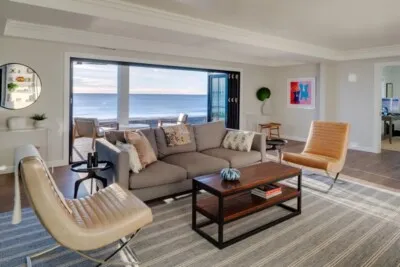
What buyers at this level encounter (the white oak floors, the kitchen with custom cabinetry and professional appliances, the primary suite with views to the sound) is the result of decisions made eighteen months earlier about material lead times, foundation elevation, and conservation commission applications. The home looks effortless because the people who built it anticipated every constraint before it became a problem.
Rapczynski's firm has spent three decades building the process discipline that makes complex projects predictable. "We deliver quality with the spare-no-expense mentality," he has said, "so that there's never a project out there that we've done that's not great." On a coastal site with this many regulatory, engineering, and logistical variables, maintaining that standard requires exactly the kind of integrated planning that a design-build firm is structured to provide: one team, one accountable entity, from the conservation commission application through the day the client receives the keys.



 Optimized by Seraphinite Accelerator